
Rugby league explained
For many Canadians, “rugby” means the 15-a-side game, rugby union. Rugby league is a 13-a-side sport with its own rules, culture and global history.
What is rugby league?
Rugby league has been introduced to Canada more recently, with much of its growth driven by increased exposure through professional teams such as the Toronto Wolfpack, the world's first trans-Atlantic professional sports team to compete in the top division of England's professional rugby league system, and the Ottawa Aces, who helped further raise awareness of the sport nationally.
Globally, rugby league has a rich and historic legacy, having separated from rugby union in 1895. This split occurred largely due to social and economic inequality in England, as working-class players sought fair compensation and greater access to the game. From these roots, rugby league developed into a fast-paced, physical and spectator-friendly sport played around the world today.
The rules of rugby league, explained
Video: Ninh Ly.
The rules
If you know rugby union, league will look familiar at first. If you know football, you'll recognize something close to “downs.”
General play
- 13 players per side
- The ball must be passed backwards, and can only be advanced by running or kicking
- Play restarts with a “play-the-ball” after a tackle: the tackled player stands and rolls the ball backward with their foot
- Knock-ons (dropping the ball forward) and forward passes result in a scrum
- Tries are scored by grounding the ball in the in-goal area, and can be followed by a conversion kick
- Drop goals may be scored during open play
The six-tackle rule
Similar to “downs” in football, a team in possession has six tackles to advance the ball. If they fail to score or kick strategically by the sixth tackle, possession is turned over to the opposing team.
Defensive structure
- There is no line of scrimmage
- After each tackle, defenders must retreat 10 metres before advancing
- This spacing creates more room, speed and attacking opportunities than in union or football
A faster, more open game
Rugby league is known for being fast-paced and highly spectator-friendly.
- Fewer stoppages than rugby union
- No contested rucks or repeated scrum resets
- No huddles as seen in football
- Continuous flow and rapid restarts
As a result, rugby league demands exceptional fitness, high involvement and more touches of the ball per player, making it exciting for players and fans.
League, union and football
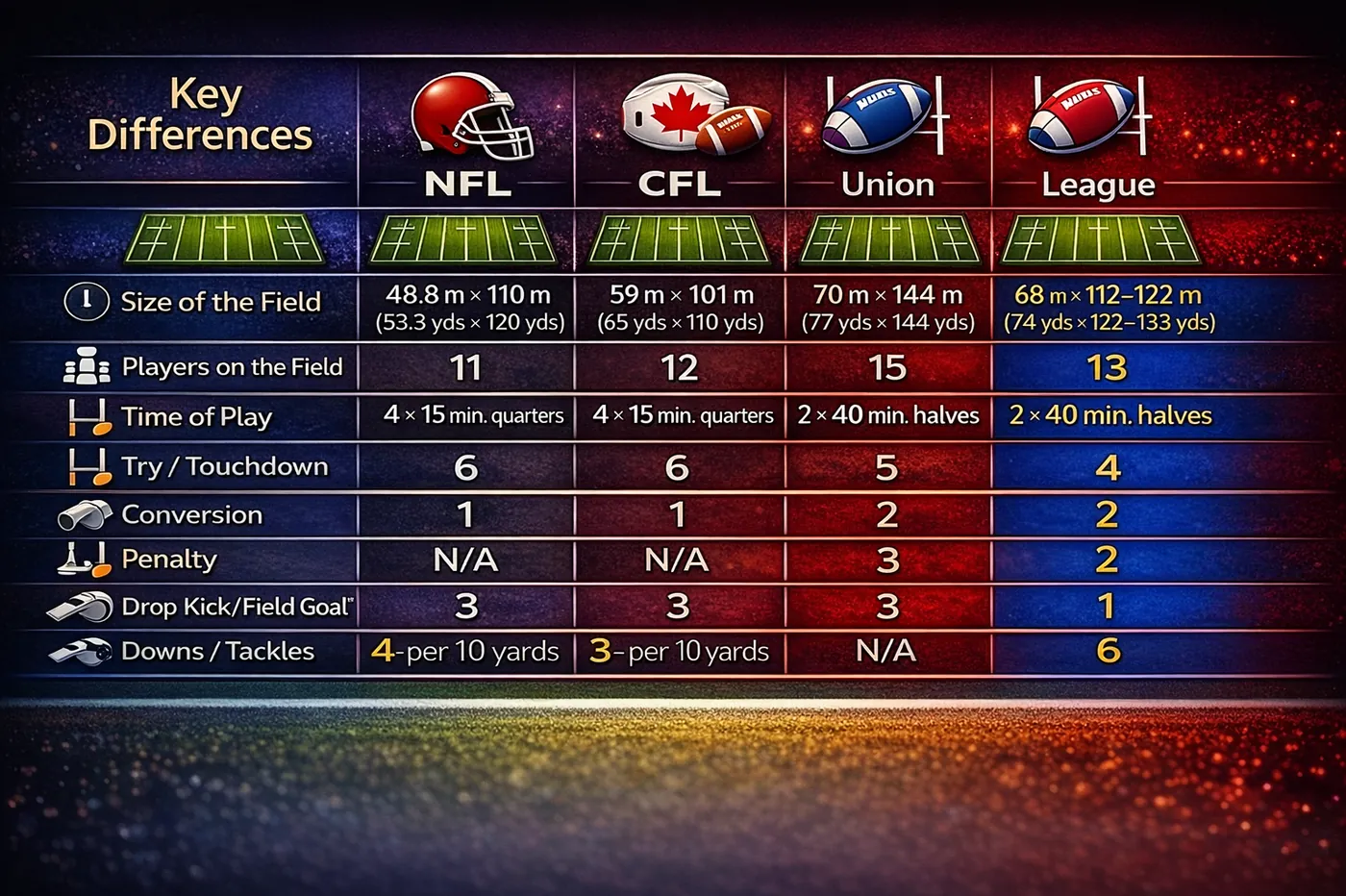
The difference between rugby union and rugby league
Video: Ninh Ly.
Where it's played
Rugby league is played worldwide, with its strongest professional competitions based in Australia and England.
Australia is home to the National Rugby League (NRL), one of the world's premier professional sporting competitions, which also includes a team based in New Zealand. England's professional system features clubs from across the country, with one team located in France.
Rugby league is the national sport of Papua New Guinea and is also widely played and supported in countries such as New Zealand, France, Wales, Ireland, Tonga, Fiji, Samoa and Lebanon.
Rugby League World Cup
The men's World Cup has been contested 15 times:
- Australia: 11 titles
- Great Britain: 3 titles, most recently in 1972
- New Zealand: 1 title, in 2008
The women's World Cup has been contested 5 times:
- New Zealand: 3 titles
- Australia: 2 titles
Ready to try it?
Clubs welcome players who have never played rugby league before.